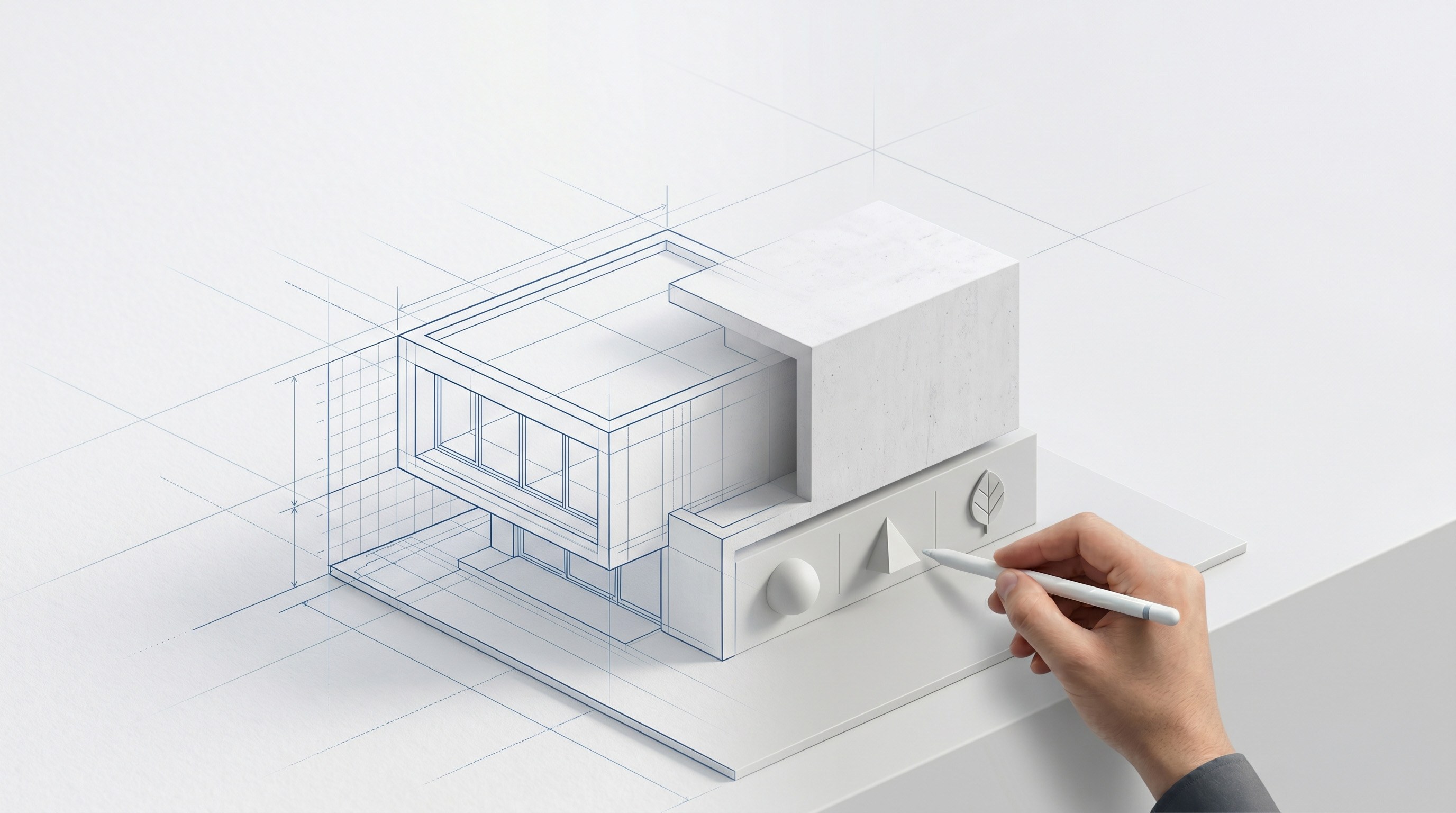
AI rendering is no longer used only for moodboards and early experiments. It is becoming part of the actual visualization workflow.
Architects are starting to use AI after the model has already been designed, not instead of designing it. That shift changes what matters. The question is no longer only whether AI can make an impressive image. The question is whether it can improve a project without breaking the decisions that already define it.
The experimental phase is ending
Early AI rendering workflows were often separated from production. A team would export an image, send it into a generic generator, and hope the result stayed close enough to the project.
That was useful for atmosphere, moodboards, and loose concept exploration, but it was difficult to trust for architectural work. Too much could change at once.
The next phase is different. AI rendering is moving closer to the tools, geometry, materials, masks, references, and decision-making process that architects already use.
The model is no longer the main story
For a long time, AI products competed mainly through model quality. Better models produced sharper images, more realistic light, cleaner materials, and stronger atmosphere.
That still matters. But for architecture, model quality alone is not enough.
The more important question is how the model is integrated into the workflow:
- Can it preserve the camera?
- Can it respect the original geometry?
- Can it modify only one selected area?
- Can it remain consistent across multiple iterations?
- Can it work with references, material intent, and existing design constraints?
A powerful model without these controls is still unreliable for professional architecture.
Architecture needs constraints
A visually impressive image is not automatically an accurate architectural image.
Windows must remain aligned. Openings must stay in place. Materials must connect logically. Furniture must respect scale. Landscape should support the design rather than hide it.
This is why masks, segments, material IDs, reference images, and geometry controls are becoming more important than the raw generative model.
In architecture, constraints are not a limitation. They are what make the output usable.
AI is becoming a production layer
The most relevant development is not just that models are improving. It is that AI is moving directly into rendering and visualization workflows.
Instead of exporting an image into an isolated AI generator, architects can increasingly work with geometry-aware data, material IDs, selected regions, and controlled source images.
AI becomes a layer between the 3D model and the final presentation.
It can enhance vegetation, people, skies, atmosphere, lighting, and selected materials while leaving the rest of the project intact.
Better control creates better collaboration
Controlled AI rendering is also useful during client communication.
A team can produce several lighting or material variants without remodeling the entire scene. The architect still makes the design decisions. AI simply shortens the time needed to visualize them.
This creates a healthier role for AI: not an autonomous designer, not a one-click replacement for rendering, but a controlled tool for faster iteration.
The future belongs to integrated models
The strongest platforms will probably not be connected to only one AI model.
Different models are better at different tasks. One model may be stronger at material realism. Another may preserve structure more accurately. Another may be better for image editing or concept exploration.
The important feature is therefore not access to a single model, but the ability to choose the right model inside one consistent workflow.
For architects, model choice should feel like choosing the right rendering mode, not leaving the project environment and starting again somewhere else.
Conclusion
The future of architectural AI rendering is not about generating the most dramatic image from a text prompt.
It is about combining powerful models with precise architectural control.
The better AI understands what may change and what must remain fixed, the more useful it becomes for professional visualization.
Main claim: AI rendering becomes professionally useful when advanced models are integrated into a controlled architectural workflow.